Gardens and Lawns on Thin Soil Over Rock in Newport County
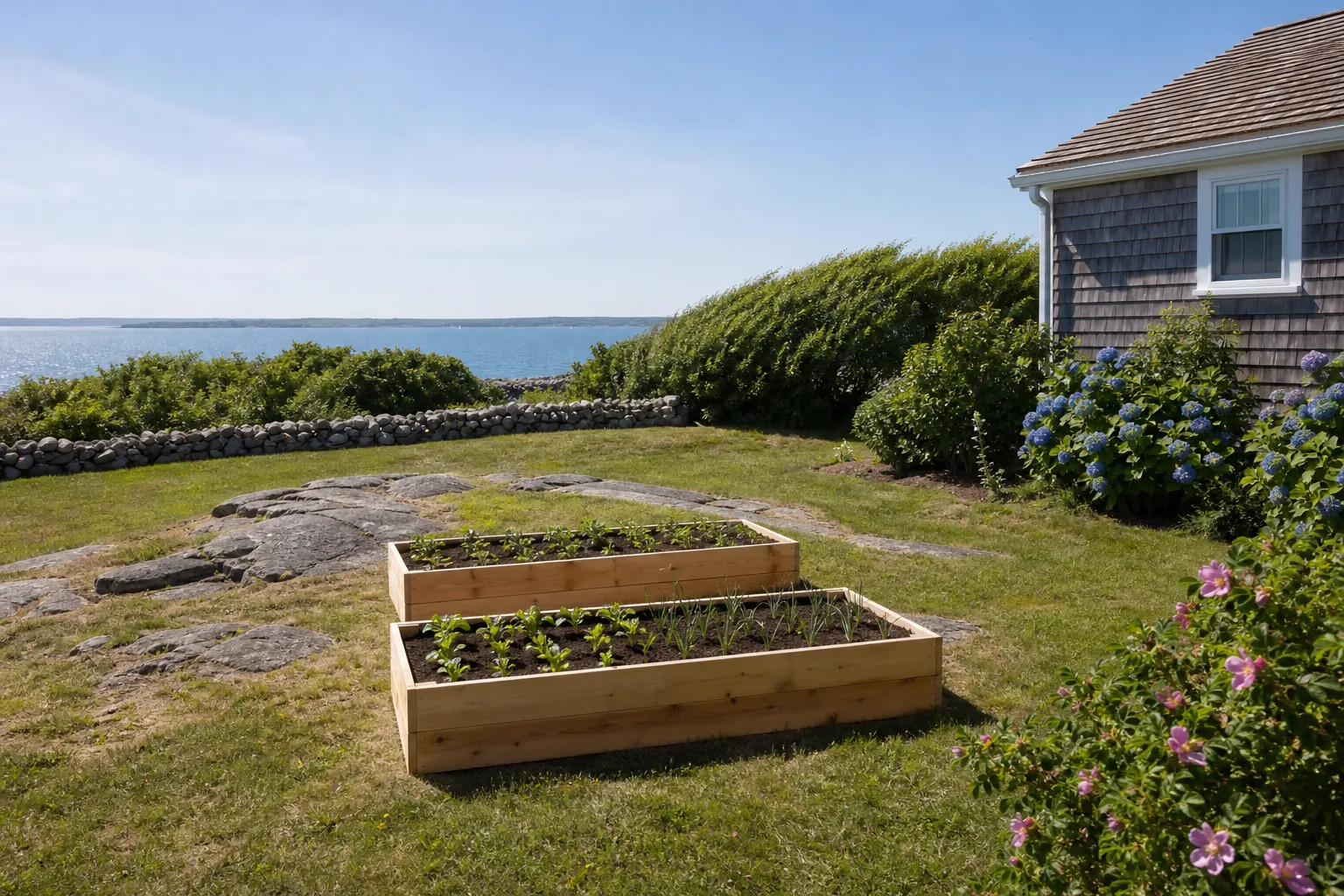
Dig a planting hole in parts of Middletown or Jamestown and the spade can stop well short of where you meant it to. Sometimes it hits ledge. Sometimes it hits a gray, brittle layer of packed till that feels nearly as hard and lets water through slowly. On Aquidneck and Conanicut the answer to both is the same: stop fighting downward and build the growing layer on top.
What sits under a Newport County yard
Start with the Newport soil series, which the Natural Resources Conservation Service maps right here. Its official description of the Newport series puts the type location in Middletown and says it formed in lodgement till "derived mainly from dark sandstone, conglomerate, argillite, and phyllite." The top 20 to 40 inches is friable, mostly silt loam. Under that sits a dense substratum the description calls "very firm, brittle," with water movement rated "low or moderately high" against "moderately high or high" in the soil above it. Bedrock under these soils is commonly more than 6 feet down, so where this series is mapped, the first hard layer a spade meets is the till, not rock.
Parts of Conanicut have less to work with. When EPA designated the island's aquifer a sole source of drinking water in 2008, its Federal Register notice for Conanicut Island described "relatively thin soil cover," glacial till "ranging from 0 to about 45 feet in thickness," and bedrock outcrops in the Dumplings and Fort Wetherill area. It also explains why the ground there stays wet for part of the year: "Because the rock and till transmit water very slowly, seasonally-high water table conditions occur throughout much of the island."
Put those together and the Newport County problem has two parts. Roots run out of room early, and water that soaks in slows to a crawl once it reaches the dense layer or the rock.
Build up instead of digging down
Breaking up hardpan or ledge by hand is a losing fight, and what you would dig out is not what you want around roots anyway. Good soil added on top gets you the depth without the demolition.
First find out how much you already have. Dig a test hole in three or four spots across the lawn or bed and measure down to where the spade stops. Write the numbers down, because they decide the order.
UMass Extension's best management practices for lawn and landscape turf, written for Massachusetts, where the Newport series is also mapped, list "shallow soil or bedrock" among the site problems worth recording, and they set the target plainly: "Provide for a minimum 6 inch depth of root zone." If your holes find 2 inches of soil over hardpan, you need about 4 more inches of screened loam to get there. If they find 6 inches or more of decent soil, a thin layer to level and seed may be all the lawn needs.
On a new house lot, deal with the packed ground before the new soil goes down. UMass says compaction from construction "should be remedied before topsoil is replaced."
Screened top soil for lawn work is listed as free of rocks, debris and large clumps, with balanced sand, silt and clay. Its page says to expect 10 to 15 percent settling over the first month or two, so to finish at 4 inches, place 4.5 to 5. The site's topsoil depth calculator puts 1,000 square feet at 4 inches at about 12.3 cubic yards; placing 4.5 to 5 inches to allow for that settling takes roughly 14 to 15.5.
Raised beds for vegetables and shrubs
Where your test holes stop at a foot or less, vegetables belong in raised beds. The topsoil calculator gives vegetable beds 12 inches and says a garden soil blend is the better material for them. Compost-blended garden soil for raised beds is sold for that job, so nobody is mixing soil, compost and amendments by hand in the driveway.
Do the bed math before ordering. A 4 x 8 foot bed filled to 12 inches holds 32 cubic feet, about 1.2 cubic yards, and the site's soil calculator warns that compost blends settle roughly 10 percent in the first weeks. For beds taller than 18 inches, the same page suggests fill dirt or coarse organic matter in the lower third, with 8 to 12 inches of garden soil on top where the roots work.
Shrubs planted in the ground are a different call. Put them where the test holes went deepest and work topsoil into the native ground around them, as the top soil page recommends. For what to plant, URI Cooperative Extension's Rhode Island Native Plant Guide lets you filter for wind tolerance and for Coastal Zone 1, which its glossary defines as tolerating "direct coastal exposure (e.g. strong winds, salt spray)." A yard facing the open water should start its list there, not at the garden center bench.
Keeping soil on a slope that drains to the water
When rain cannot soak through the dense layer, it runs across the surface, and on a sloping lot it takes loose soil along. New loam and freshly seeded banks are the most exposed until roots knit them.
Cover bare ground on a slope with shredded hardwood mulch. Its product page says the shreds knit together on sloped areas to limit rain and wind erosion, and the site's mulch calculator warns that chips and nuggets can float off in a downpour. Light mulches do worse on an exposed lot. UConn's Home and Garden Education Center notes that buckwheat hulls and cocoa shells will blow away in windy spots.
Where water gathers into a line, at a downspout or along a low swale, give it a channel of rounded river rock, 1 to 3 inches. Its page lists drain runs, swales and downspout outlets among its uses and says to place the stone after the drainage route is set. Aim that water at a dry well or a safe low spot on your own property, never at the neighbor's lot.
If the slope ends at the shore, call the Coastal Resources Management Council before you regrade or add stone there; work within 200 feet of a coastal feature needs its permit.
Let the test-hole numbers write the order. The bed where the spade went in 3 inches and the corner where it went in 10 are not the same job, so size each area to its own depth instead of using one figure for the whole yard, add them up, and have the loam for your Newport or nearby island delivery tipped where the wheelbarrow run to the thinnest ground is shortest.
Common questions
Does Newport County soil need lime?
Test before you spread any. The NRCS describes the Newport series as strongly acid in its typical profile, ranging from very strongly acid to slightly acid where the ground has not been limed. A pH test tells you how much, if any, to add. URI Master Gardeners offer free soil pH testing at their Gardening Information and Soil Testing booths around the state.
Is loam the same thing as topsoil?
Not technically. UConn's guide to purchasing topsoil calls topsoil the uppermost layer of soil and loam a texture class: between 7 and 27 percent clay, 28 to 50 percent silt and less than 52 percent sand. Rhode Island landscapers use "loam" to mean screened topsoil, so when you buy it, ask what the pile's texture actually is.
How deep should river rock go in a bed or swale?
The river rock product page puts the usual depth at 3 inches, which it says gives the stones enough weight to stay put through freeze and thaw. It adds that going past 4 inches uses more stone without changing the look, so a deeper bed is money spent on stone nobody sees.